Introduction
Imagine having a conversation with an avatar that listens, shows emotions, and responds like a real person—not just with text, but with facial expressions, voice tone, maybe even gestures. What if this avatar could help you learn, shop, attend therapy or just be a companion, anytime, anywhere?
We already have powerful AI like ChatGPT and Gemini—great at text and voice—but digital humans are taking things further. They are the next phase: AI avatars that behave like real humans. Technology, imagination, and ethics are all mixing together. This article explores what digital humans are, why they matter, their challenges, and where they’re heading.
What Are Digital Humans?
Definition & Key Features
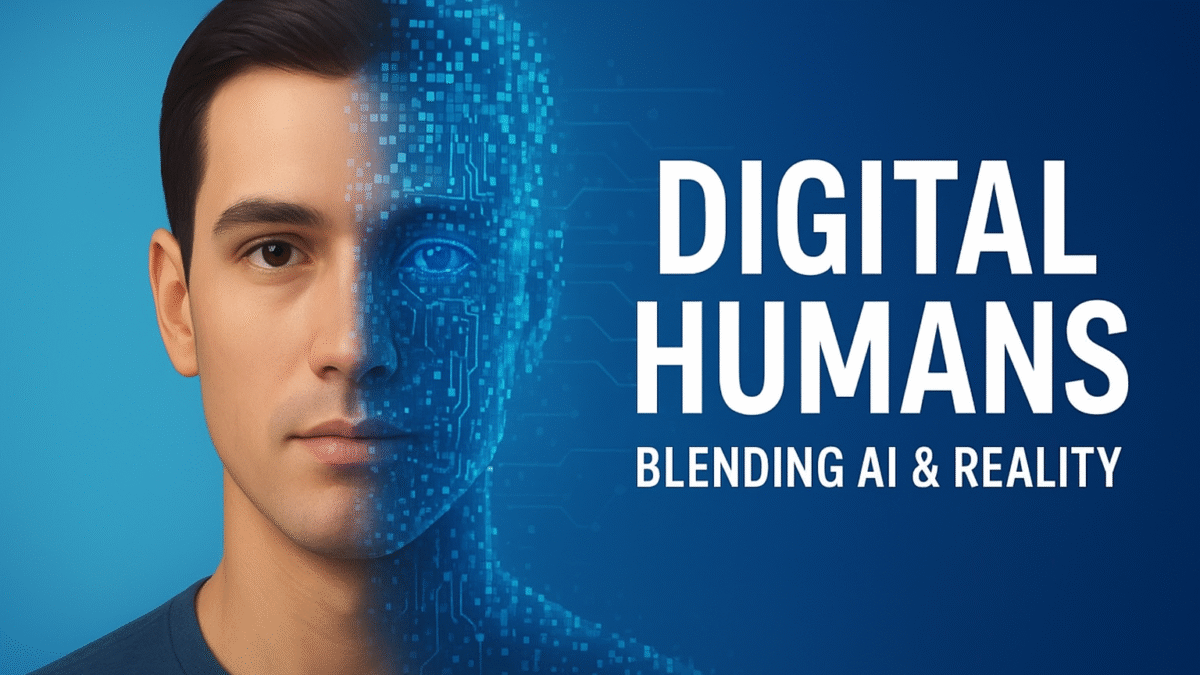
Digital humans are AI-powered avatars—2D or 3D—that can mimic human-like behaviors. They combine:
- Natural language processing: understanding and generating speech or text.
- Facial expressions, body language, gestures to create realism.
- Emotional intelligence: recognizing user mood, adjusting tone.
- Visual realism: skin texture, eye movement, lip sync, etc.
How Are They Different from Chatbots like ChatGPT and Gemini?
| Feature | ChatGPT / Gemini | Digital Humans |
|---|---|---|
| Mostly text (and voice) | Text & voice + visual/avatar presence | |
| Conversation only through words | Adds facial expressions, gestures, visual cues | |
| Responds based on prompt / training | More immersive interaction with emotional & visual feedback | |
| Limited sense of “presence” | Feels more like interacting with a “person” rather than a bot |
Why Digital Humans Are Emerging Now
Technological Advances
- AI / Deep Learning improvements (vision + voice + language).
- Better graphics engines and real-time rendering (e.g. Unreal Engine’s MetaHumans) allow very lifelike avatars. Synthesia
- Faster compute and cloud infrastructure so responses and avatars feel instantaneous.
Demand for Richer Interaction
People want things more human-like: empathy, presence, emotional connection. Purely text-based systems can feel cold. Digital humans are a way to make interactions richer. Studies show perceived humanness and interactivity increase trust in chatbot-like systems. BioMed Central
Use Cases are Expanding
- Education: digital mentors or teachers that can visually demonstrate, guide, interact.
- Healthcare and mental health support.
- Customer service: virtual customer agents that feel more “alive.”
- Training simulations.
- Virtual influencers, entertainment, metaverse.
One startup, Anam, is building digital human avatars that can have lifelike conversations for clients in education, sales, healthcare, etc. Business Insider
Another company, UNITH, specialises in digital avatars that look, sound, and interact like real people—usable for websites, customer support etc. Wikipedia
Research & Experiments: What We’ve Learned
Usability & Preference Studies
- A randomized controlled trial compared a digital human interface vs. a text-only chatbot when giving mental health support. It found that the text-only chatbot scored higher in system usability; the digital human was less user-friendly in that specific setting. PMC+1
- However, both interfaces achieved average or above-average usability, showing the digital human approach isn’t unusable; just that there are trade-offs. PMC
Psychological Effects
- People interacting with more human-like AI tend to trust them more, feel more socially satisfied. But there’s also risk of emotional dependency. arXiv+1
- Users’ perceived humanness, interactivity, and enjoyment influence their willingness to adopt and use such systems. BioMed Central
Use Cases & Real-World Examples
Anam
Anam builds digital humans that can have lifelike conversations. One-Shot is a feature letting you create a persona from a single photograph, used in language-learning, sales, healthcare. Business Insider
Synthesia
Synthesia makes expressive avatars and video avatars for corporate communications among other uses, letting users create videos with digital humans instead of filming. Synthesia+1
UNITH
UNITH’s Digital Human platform lets companies put avatars on websites to interact with visitors 24/7; these avatars look, sound, and behave like real people. Wikipedia
Hanson Robotics / Sophia
Physical robots or humanoids like Sophia show how digital humans (combined with robotics) bring a mix of AI conversation + expression + presence. Sophia can recognize faces, sustain eye contact, and produce many facial expressions. Wikipedia
Ameca
Ameca, by Engineered Arts, is designed for human interaction: gender-neutral appearance, expressive, responsive. Wikipedia
Opportunities & Benefits
- More Natural Interactions
We respond not just to what is said, but how it’s said, the body language, facial expressions. Digital humans give more cues. - Better Engagement & Trust
Users tend to trust systems more that feel more human-like. Helpful in healthcare, customer service. - Scalability + Empathy
Digital humans can operate 24/7, in many languages, many locations, without fatigue. Yet if done well, they can still show empathy (or simulate it). - New Kinds of Accessibility & Inclusion
For people with disabilities, or remote learners, or isolated individuals, digital humans could give a richer interface. - Entertainment, Marketing, Creativity
Virtual influencers, avatars in games/metaverse, immersive storytelling—all get better with more lifelike digital humans.
Challenges & Risks
- Technical Complexity & Cost
Building and maintaining realistic avatars is expensive: high-quality graphics, motion capture, emotion recognition, voice synthesis, etc. - Uncanny Valley & User Discomfort
If the avatar is almost but not quite human, it can feel creepy. Getting facial expressions, eye movement and lip sync perfect is hard. - Privacy, Deepfakes & Identity Issues
When avatars look like real people, or when someone’s appearance is cloned, misuse risk arises. Deepfake concerns. - Emotional Dependency & Ethical Concerns
Users might become overly dependent on digital human companions, affecting human relationships. The ethics of simulating empathy and consciousness. - Usability Issues
The mental health avatar trial showed digital humans may score lower on usability in text vs visuals settings. Choices of modality matter. PMC - Bias, Representation, Cultural Sensitivity
How avatars look, speak, the life experiences they reflect—all can carry biases. They must be inclusive, avoid stereotyping.
What Needs to Happen Next
- Advances in multimodal AI: better integration of vision, voice, text, gesture.
- Real-time emotion & context awareness: detecting mood, adjusting behavior.
- Better avatar design tools and pipelines, so it’s easier and cheaper to make good ones.
- Strong ethical guidelines, regulation for identity, data privacy, misuse.
- User-centric design & testing, especially in sensitive domains (therapy, education).
Frequently Asked Questions
- Will digital humans replace humans entirely in customer service or therapy?
Probably not fully. For simple tasks, yes, but for deep emotional work, complex judgment, human presence still matters. - Do people prefer digital humans over chatbots?
It depends. Some research shows people value humanness and interactivity, but usability, familiarity, trust, modality (text, voice, visual) all affect preference. BioMed Central+1 - Are digital humans just gimmicks?
No — there are already solid use-cases (training, education, support). But in some contexts, it can feel gimmicky if the realism or usefulness isn’t there. - How soon will this be widespread?
Already happening. Startups like Anam, Synthesia, UNITH are already working with clients. With improvements, more sectors will adopt. - What about cultural or language limitations?
Significant challenge. Avatars need to be culturally sensitive, speak many languages well, adjust for accent, expression norms, etc.
Summary
Digital humans are the emerging next wave of AI: avatars that go beyond text, combining speech, visuals, expression to simulate human-like interaction. They build on things like ChatGPT and Gemini, but add presence. The benefits are many: richer engagement, trust, potential in education, healthcare, entertainment. But technical, ethical, and usability challenges remain big. It’s not a replacement of humans in most domains—but a powerful augmentation.
What Should You Do Next?
- If you are a business or organization: Start experimenting with digital human platforms. Pilot low-risk use cases. Collect feedback.
- If you are a developer or researcher: Focus on improving emotional intelligence, realism, latency, and reducing bias.
- If you are a user: Try interacting with digital humans, note what feels good vs what feels strange. Your feedback matters.
Call to Action
If you found this post useful, please share it with someone curious about the future of AI, or comment below: What aspect of digital humans excites you most? What scares you?
References / Trusted Sources
- Usability study: Usability Comparison Among Healthy Participants of an Anthropomorphic Digital Human and a Text-Based Chatbot — PMC / PubMed. PMC+1
- Consumers’ psychological response to chatbots: Interactivity, Humanness, and Trust — BMC Psychology. BioMed Central
- Companies building digital humans: Anam’s recent $9 million funding for digital avatars. Business Insider
- Synthesia valuation and work in avatars. Financial Times